The Propeller - Propelling you into the new week! Tips, Newsbites, and Wisdom covering Life, Technology, Entrepreneurship, Finance, and the Internet

The Propeller – Life Changing AI Prompts, FedEx, and Tax Efficiency – An Eclectic Mix! – 11-30-2025

Everyday AI: 7 Prompts to Create a Life-Changing Agent


Most people think of AI as a quick-answer tool or to just write random emails and documents, but that’s just scratching the surface. The real power of AI lies in building agents that act like full-time partners: planning, analyzing, writing, organizing, and even making decisions for you. Here are 7 transformative prompts that turn AI into a life-changing assistant for both your personal life and your work. And here’s the best part, I share strategies like this every week to help you harness AI and AI Agents to completely upgrade how you live and work.

Use these to change your life

Identity Builder
“Create the identity of my personal AI agent. Define: • name • personality • communication style • strengths • decision-making rules • boundaries Base it on my needs: [what tasks you want help with].” 

Role Assignment Engine
“Define all the roles my AI agent should take on. Include: • productivity coach • researcher • writing assistant • strategist • project manager • habit accountability partner Customize them based on my goals: [your goals].” 

Knowledge Base Constructor
“Create the knowledge base my AI agent should use. Include: • my work context: [describe your work] • my goals: [goals] • my habits: [habits] • my schedule: [schedule] • my communication preferences Then tell me what extra info I should provide for best results.” 

Task Flow Automation
“Build a system where my AI agent: • receives a task • breaks it into steps • asks clarifying questions • performs research • drafts deliverables • summarizes results • gives next actions Create this workflow for the tasks I do most often: [your tasks].” 

Thinking Style & Reasoning Rules
“Define the thinking style my AI agent should use. Choose from: • analytical • strategic • creative • systems thinking • rapid decision-making Apply it to: [your field or goals]. Then create explicit rules for how the agent should reason, evaluate info, and propose solutions.” 

Long-Term Memory System
“Design how my AI agent should store, update, and retrieve information over time. Include: • personal details • preferences • ongoing projects • deadlines • habits & progress Tell me what type of info I should upload regularly and how often.” 
 
Daily & Weekly Interaction Blueprint
“Create a structured routine for how I should interact with my AI agent. Include: • daily check-ins • weekly planning • monthly reviews • how the agent should track my goals • how it should notify me of problems Customize it to my lifestyle: [describe your daily routine].” 


The FedEx Story: From a C on a Paper to a $6.3 Billion Deal


In 1965, a Yale economics professor handed Fred Smith a grade that would change the world: C.

The note was blunt:
“Interesting concept, but to earn better than a C, the idea must be feasible.”

The idea? Overnight package delivery.

Back then, the United States Postal Service had a monopoly. Shipping took 3–5 days, sometimes a week. Businesses waited. Production lines stalled. Everyone accepted it as “just how shipping works.”

Fred didn’t.

Growing up in Memphis, losing his father at age four, watching his mother fight to keep the family business alive, he learned early that broken systems need bold solutions.

After Yale, Smith flew combat missions in Vietnam. He saw something the business world hadn’t: the military moved critical supplies overnight to remote bases. If they could do it in a war zone, why not in America?

Smith returned home convinced. He inherited $4 million, raised $91 million more, bought planes, hired pilots, and built a hub in Memphis.

April 17, 1973: Federal Express launched with 186 packages. 25 cities. One radical promise: overnight delivery.

The Postal Service laughed.
“Nobody needs overnight delivery.”
“Three to five days is fine.”
“You’re wasting your money.”

FedEx lost $1 million a month. Fuel prices spiked. Investors panicked. One Friday, the company had $5,000 left, needed $24,000 for Monday’s flights. Without it, FedEx was dead.

Fred Smith flew to Las Vegas. Sat at a blackjack table. Turned $5,000 into $27,000. Made payroll. Fueled planes. Survived another week.

The gamble bought time. Smith pitched harder. Investors doubled down. By July 1975, FedEx turned its first profit: $3.6 million, delivering 19,000 packages a day.

By 1983, FedEx hit $1 billion in revenue, the fastest in U.S. history without mergers. The Postal Service scrambled to copy overnight delivery. Too late. FedEx owned the market.

Then came the ultimate irony:
In 2001, USPS signed a $6.3 billion deal with FedEx to handle all its overnight and express mail.

The monopoly that called Smith’s idea “unfeasible” paid him billions to do it.

Today, FedEx moves 6.5 million packages daily. Revenue: $90 billion. Worth: $70 billion. And the phrase “Absolutely, positively overnight” changed global business forever.

The Lesson

This isn’t about gambling. It’s about conviction.

When the monopoly says it won’t work…
When the professor says it’s “unfeasible”…
When the industry says you’re wasting your time…

You need one thing: unshakeable belief that you see something they don’t.

Fred Smith didn’t bet on blackjack. He bet on himself. Against USPS. Against every expert. And he won so decisively the monopoly had to hire him.

So ask yourself: What idea did someone tell you was “unfeasible”? Maybe they just can’t see what you see.

Stop waiting for an A.  Build the empire anyway. Don’t quit.

Asset Location For Tax Efficiency

Where you put your investments can make a huge difference for your after-tax wealth.

As you know, we have 3 main investment accounts:

  1. Taxable account. A traditional brokerage account where you are taxed every time you dividends or sell investments at a gain.
  2. Tax deferred account. Traditional 401(k), 403(b), and traditional IRAs allow taxes to be deferred to the future. You pay taxes when your investments are withdrawn, and generally come with an immediate tax deduction.
  3. Tax exempt account. Roth IRA, Roth 401(k), and Roth 403(b) allow you to avoid future taxes while providing no immediate tax deduction. The growth of these accounts is tax free.

Asset location

Say, as part of your investment strategy, you want to start putting money in bonds. You have a 401(k), Roth IRA, and a brokerage account. Where do we put them?

Brokerage account

When you hold bonds, like BND (Total Bond Fund ETF), you pay taxes on non-qualified dividends (e.g. interest from the bond) up to a max rate of 37%, plus net investment income tax, if applies. This means that if you receive $1,000 from the bond, you will pay approximately $370 in taxes if you are in the highest tax bracket.

Of course, not all of us are in such bracket, and perhaps a more reasonable number would be ~$220-240 for most people. But is taxable brokerage the right choice for you? Not really. You would be paying $200+ every year, plus state/local taxes.

Personally, I’m 100% invested in equities, because I want to be aggressive with my portfolio in my 20s, but if I did have bonds, I wouldn’t hold them in a brokerage account.

Roth IRA/Roth 401k

When you purchase bonds in a Roth IRA, you will not pay taxes on the interest since it’s a tax-free account!

That’s much better than the $200+ in taxes you would pay in a brokerage account.

But is it the best choice? Well, bonds are considered “fixed income” funds, and they don’t grow much. Since Roth IRA is a tax-free account (meaning we pay no taxes when we sell these investments), we want as much growth as possible in it. Bonds would hinder that performance.

So, holding bonds is here better than brokerage, but likely not the most ideal place.

Traditional 401(k)/403(b)

By holding bonds in an account like a traditional 401(k)/403(b), the interest income avoids immediate taxation, compounding tax free until withdrawal.

So, we avoid the ~$200+ of taxes and aren’t sacrificing the tax-free compounding like we are with a Roth IRA. This makes the pre-tax 401(k) the perfect location for bonds.

Of course, the 401(k)/403(b) choices are limited and are provided by your employer. So, if they don’t offer a bond fund, you might not have a choice.

Some other examples:

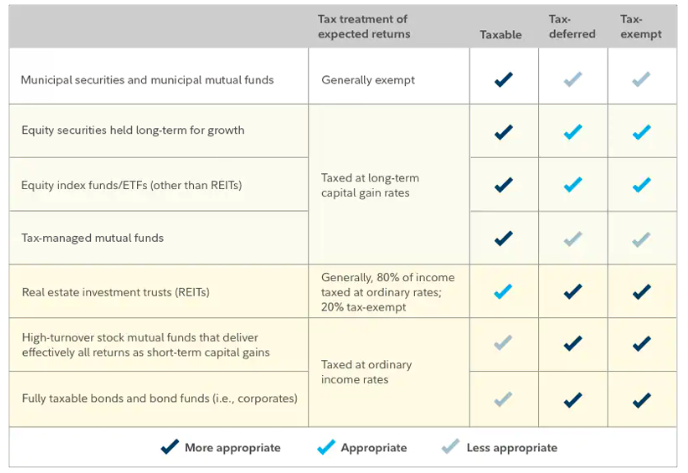
  • REIT stocks/ETFs also pay non-qualified dividends and would follow similar logic like bond funds.
  • Actively managed funds (I’m strongly against these, as I believe passive funds are the best & lowest fees) have a lot of turnovers, so they ideally shouldn’t be in a brokerage account due to capital gain distributions.
  • Stocks that pay 0% dividends (like Netflix) are the most efficient to hold within the brokerage account but may need a more robust overall investing plan.

I really like this visual from Fidelity to reference:

But how much does this matter? Vanguard’s research finds that a thoughtful asset location strategy can add significantly more value than an equal location strategy. The value added typically ranges from 5 to 30 basis points of after-tax return, depending on circumstances (e.g. income, portfolio size)

Quote of the Week

“If you think someone lacks creativity, take a closer look at their excuses, they’re often masterpieces in disguise.”
Leonard Mack

This quote, which is part of my new book coming out soon, highlights an ironic truth: excuses often require imagination, resourcefulness, and storytelling. When people justify why they can’t do something, they frequently craft elaborate narratives filled with creative reasoning. The insight suggests that creativity isn’t absent, it’s just misdirected. Instead of using that ingenuity to solve problems or innovate, it gets channeled into avoiding action. The takeaway? Creativity is universal; the challenge lies in redirecting it from excuses to execution.

I can’t believe it is almost December!


This is re-published from the weekly email sent by Leonard Mack entitled The Propeller.  To subscribe, visit https://www.LeonardMack.com/subscribe and read it every Sunday evening.


This intellectual nourishment is intended for informational purposes only. One should not construe anything herein as being legal, tax, investment, financial, or other advice.


My rule is this – I have no advice to give, only experience to share. I have no interest in being a guru or telling people what they should do. Rather, I share my own experience because there is no right or wrong. Your mileage may vary.